

Commentary
Evan A. Feigenbaum
{
  "authors": [
    "Evan A. Feigenbaum"
  ],
  "type": "commentary",
  "blog": "Emissary",
  "centerAffiliationAll": "dc",
  "centers": [
    "Carnegie Endowment for International Peace"
  ],
  "collections": [
    "China and the World",
    "Dynamic Governance Risks in Asia"
  ],
  "englishNewsletterAll": "asia",
  "nonEnglishNewsletterAll": "",
  "programAffiliation": "AP",
  "programs": [
    "Asia"
  ],
  "regions": [
    "Central Asia",
    "China",
    "Russia",
    "India"
  ],
  "topics": [
    "Trade",
    "Foreign Policy",
    "Economy"
  ]
}
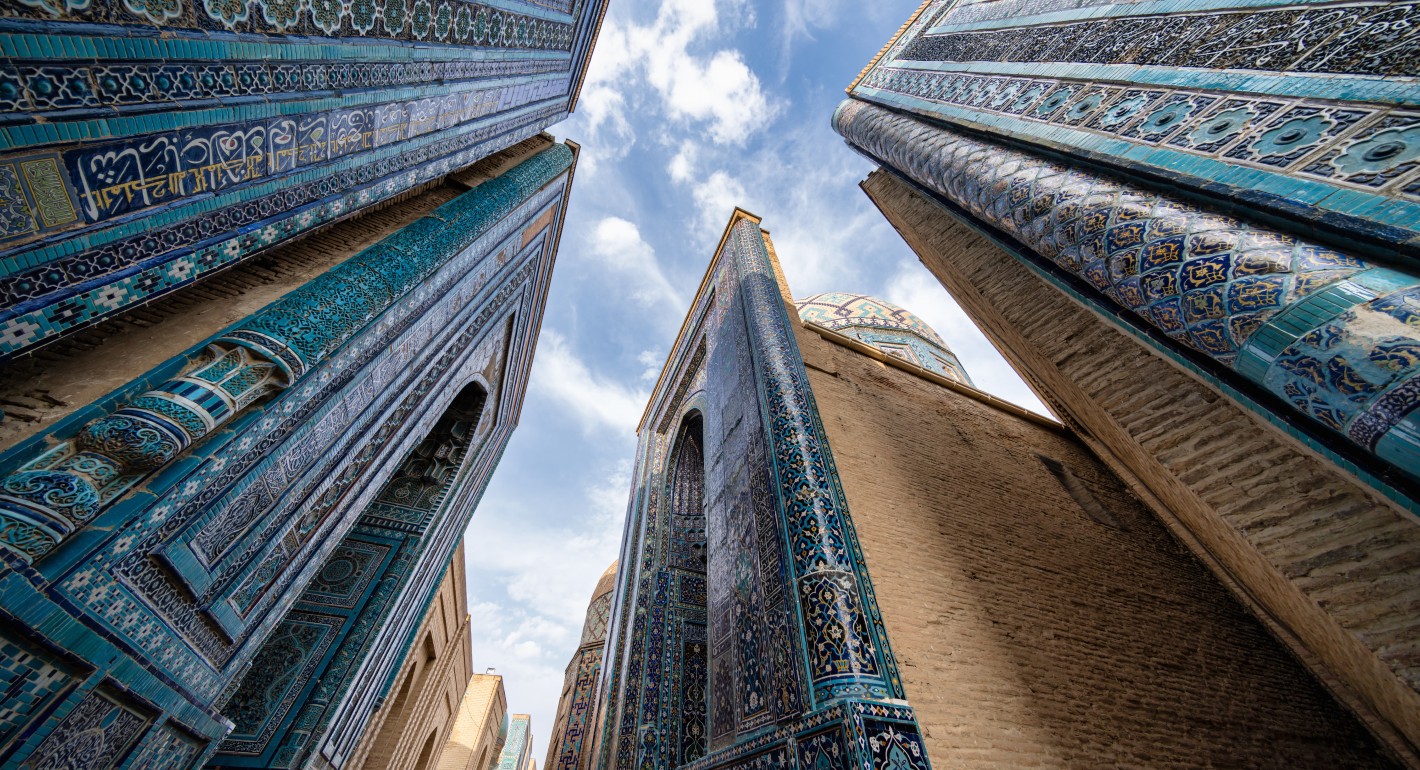
Shah-i-Zinda necropolis in Uzbekistan. (Photo by Mlenny/iStock)
Xi, Putin, and other regional leaders are back-slapping in Bishkek, but the SCO has yet to answer the most serious questions about continental Asia's economic future.
This week, leaders from China, Russia, India, Iran, and Central Asia have been meeting in Bishkek, Kyrgyzstan, for the Shanghai Cooperation Organisation (SCO) summit. The gathering has elicited commentary about how the SCO’s role as Russia’s “backyard” is being supplanted as China “conquers” central Eurasia. But in light of the past twenty years, this view of the Russia-China dynamic is pretty ahistorical.
For one thing, the SCO is a Chinese, not Russian, vehicle. It grew out of its former incarnation as the Shanghai Five, composed of China and bordering states, that attempted to facilitate border stability and settlements.
For another, we have long since passed the point of China’s “arrival” in continental Asia. China has been a very significant part of the economic landscape for roughly two decades. As an example, when I handled Turkmenistan policy for the United States as the deputy assistant secretary of state for the region during president George W. Bush’s second term, China was already in Turkmenistan’s gas mix and had the only onshore production sharing agreement in the country—a venture at Bagtyýarlyk in Lebap Province.
The more salient question is not about China supplanting Russia in the region, but about how China’s already sizable footprint is being remade in significant ways.
Chinese investments and economic agreements—which are largely bilateral and not undertaken principally through vehicles like the SCO—have shifted beyond extractive industries including oil, gas, and mining to new industries that include renewable energy (see Uzbekistan) and the digital space. China has also moved from bringing in Chinese labor—as was done in Tajikistan, where I once asked then foreign minister Talbak Nazarov why I constantly saw Chinese workers on the roadsides around Dushanbe—to upskilling local labor. This is important because it explains why China’s offerings have become more responsive to demand-side pull from local governments, firms, and markets and thus aligned with more of their long-term development objectives than when China first arrived as a leading economic player in post-Soviet economies.
But a core question is how to ensure that this Chinese economic activity actually leaves more of the value-add in the region itself. That would mean, for example, that people in Kazakhstan are not standing by the tracks waving at passing trains in a transit-first approach to Chinese engagement. Instead, the government and local partners should be pushing to capture more value-add locally and diversify those economies. I still have serious questions around that part of China’s obvious and significant economic footprint.
As for the SCO itself, I have been speaking and writing about it for twenty years, yet two unknowns remain:
First, is the SCO largely performance art and anti-American theater? Or is it yielding meaningful collaboration and economic integration in a region where many of the SCO members—such as India and Pakistan—are strategic rivals?
The fact is that cross-border linkages would be the actual key to regional development in continental Asia. But the post-Soviet history of Central Asia has been absolutely littered with an alphabet soup of organizations: SCO, CSTO, EURASEC, ECO, the CIS summits, and so on. Yet the body of evidence suggests that serious economic development will require cooperation—not least because many of these countries are landlocked, which raises transaction costs and has debilitating economic consequences—so those underlying strategic rivalries simply don’t yield complementary policies.
Second, the biggest improvements actually have been among Central Asian states themselves, not the outsiders: India, Pakistan, and Iran, much less Russia, which has plenty of non-tariff barriers that are designed to protect Russian industry, not enable Kazakhstan’s or Uzbekistan’s industry.
In the mid-2000s, before the Chinese Belt and Road Initiative even existed, the United States and institutions such as the World Bank and the Asian Development Bank were the principal players promoting regional integration. China was barely in the picture yet—and, ironically, spent a lot of propaganda time actually condemning the American promotion of regional integration as a nefarious “scheme.” But to be honest, we were a lot more enthusiastic about integration of roads, power lines, and customs than the regional states themselves were. And this is partly why initiatives we promoted—like the Central Asia Regional Economic Cooperation Program—didn’t get as much traction as we hoped. A huge obstacle was strategic, political, and interpersonal rivalries among the countries. For example, under former president Islam Karimov, Uzbekistan had major rivalries with neighboring states and managed like clockwork to blow up or disrupt nearly every piece of regional architecture it joined—joining and withdrawing from some of the above-named groups with an almost amusing predictability.
That has changed under President Shavkat Mirziyoyev, so at least there is a core of collaboration among local countries in the heart of Eurasia that didn’t exist two decades ago. But for all the rah-rah about the so-called Middle Corridor and other schemes, the SCO has nothing to do with these. And there are still underlying strategic rivalries because of China, Iran, Russia, India, Pakistan, and so on (before we even get to the problem of Taliban-ruled Afghanistan) that often stymie progress in the region.
The most decisive issue for the SCO’s member countries remains the high barriers and many obstacles around “soft” infrastructure—not the roads and rails that China and others have made the focus of their approaches, but rather some of the enabling backbones of economic life: crossing a border, clearing a customs checkpoint, sharing water and electricity, or irrigating land. For decades, SCO member states have been theoretically dependent on one another if they actually want to promote serious development and tangible economic diversification. Yet this reality of mutual dependence was, is, and will almost certainly remain deeply disquieting to some of those whose acquiescence will be necessary to make it happen.
A version of this post originally appeared on LinkedIn.

Vice President for Studies
Evan A. Feigenbaum is vice president for studies at the Carnegie Endowment for International Peace, where he oversees work at its offices in Washington, New Delhi, and Singapore on a dynamic region encompassing both East Asia and South Asia. He served twice as Deputy Assistant Secretary of State and advised two Secretaries of State and a former Treasury Secretary on Asia.
Recent Work
Evan A. Feigenbaum
Evan A. Feigenbaum
Carnegie does not take institutional positions on public policy issues; the views represented herein are those of the author(s) and do not necessarily reflect the views of Carnegie, its staff, or its trustees.

The real test may come after the leaders leave the room.



Sheena Chestnut Greitens, Oriana Skylar Mastro, Yukon Huang, …

U.S. trading partners in Asia are closely watching the dispute for signs of how it may affect their own interests.

Barbara Weisel
Lee’s tour shows how Seoul is reorganizing its diplomacy away from Pyongyang and toward industrial networks and the geography of the compute economy.

Darcie Draudt-Véjares
“AI safety in parallel” is modest and pragmatic but vital.

Matt Sheehan
Beijing regulated AI—and then Chinese AI companies took off.
Matt Sheehan