Introduction:
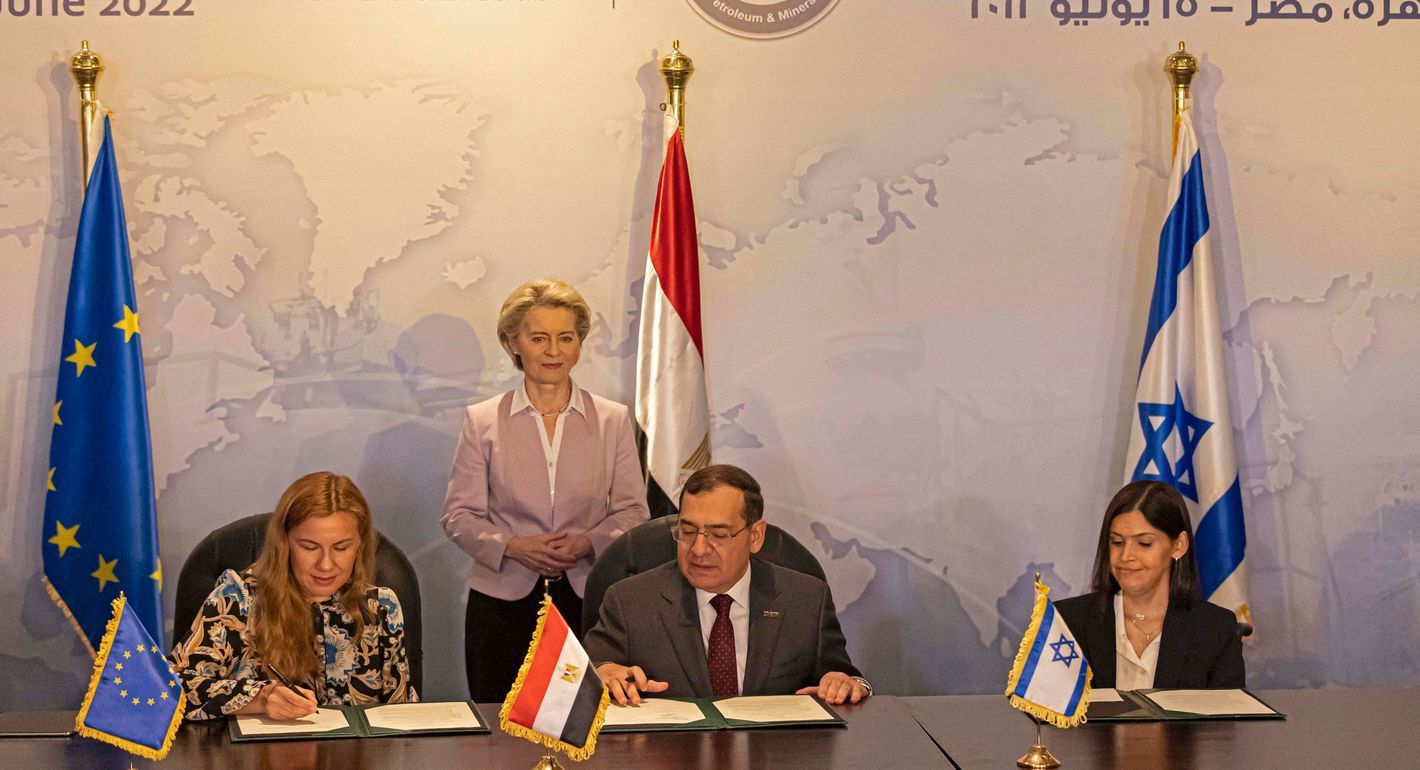
In December 2025, Israel and Egypt announced the signing of a new gas deal that significantly expanded their pre-existing 2018 agreement and extended its duration through 2040. The two countries also formally reapproved amendments to the trilateral Memorandum of Understanding (MoU) signed by Egypt, Israel, and the European Union in 2022, under which Israel is expected to increase its natural gas exports to Egypt for liquefaction at Egyptian LNG facilities and subsequent re-export to European markets.
The formal ratification of these agreements took place against a backdrop of acute political and security tensions between Egypt and Israel, as well as broader regional instability following the 7 October attacks and the subsequent genocide in Gaza.
Israeli Prime Minister Benjamin Netanyahu asserted that the agreement would significantly strengthen communication and strategic relations with neighboring countries and contribute to regional stability, while stressing that it had been approved only after Israel’s vital security interests had been safeguarded. On the Egyptian side, Diaa Rashwan, Chairman of the State Information Service, characterized Netanyahu’s remarks as political messaging intended to mitigate Israel’s international isolation following its violent military aggression on Gaza. Rashwan, by contrast, described the agreement as a “purely commercial transaction” that would strengthen Egypt’s position as a regional hub for natural gas trading.
The agreement, however, cannot be understood in isolation from the broader regional and international political and security context in which it was concluded. Three factors are particularly important. First, the agreement was reached despite the sharp deterioration in political and security relations between Egypt and Israel since October 7. Second, Egyptian-Israeli gas cooperation is intertwined with European interests in securing LNG supplies. Europe has an interest not only in receiving additional gas but also in regional stability, particularly given concerns over irregular migration and the stability of Egypt and the southern Mediterranean. Third, American and European energy companies have significant commercial interests in the gas fields and logistical infrastructure underpinning the agreement. The protection of these investments creates an additional incentive to preserve gas flows and the infrastructure on which they depend.
This entanglement of economic, political, and security interests, whereby commercial agreements are pursued not only for financial gain but also as instruments for containing or mitigating escalating conflict, is not unprecedented. In political science, this dynamic is often associated with the concept of Change Through Trade (Wandel durch Handel), which is rooted in liberal approaches such as Commercial Peace Theory and Interdependence Theory. These perspectives argue that economic interdependence between potentially conflicting parties creates incentives to protect shared economic interests, reduce tensions, and maintain peace.
Germany has strategically incorporated this logic into its foreign policy, most notably in its relations with Russia before the invasion of Ukraine. A similar logic has informed aspects of U.S. foreign policy toward protracted conflicts in which a decisive political settlement has appeared elusive. A case in point is the Arab–Israeli conflict, where conflict management has at times been regarded as the only possible course of action. The Abraham Accords further illustrate this logic, integrating economic cooperation in strategically significant sectors, including energy and technology, as a catalyst for political and security cooperation and stability.
Statements by Tom Barrack, the U.S. Special Envoy to Syria and a prominent businessman close to President Trump, similarly reflect this perspective. Barrack has argued that some conflicts in the Middle East may not have a definitive endpoint and that stability may instead depend on creating shared interests and stronger economic ties among parties to conflict.
But what are the limits of the change that shared economic interests can produce? Can economic interdependence reduce the likelihood of conflict and contribute to lasting peace, or does it ultimately constitute a gamble not only with political and security interests, but also with economic stability?
The German–Russian Gas Experience:
Change Through Trade under Willy Brandt and Angela Merkel:
West Germany began incorporating the Change Through Trade (Wandel durch Handel) approach into its foreign policy during the 1970s, when Chancellor Willy Brandt pursued closer economic and diplomatic relations with the Eastern Communist bloc, including the Soviet Union, Eastern European states, and East Germany. This approach formed part of a broader strategy of political normalization known as Neue Ostpolitik, or the “New Eastern Policy,” which sought to reduce tensions and promote greater engagement between West Germany and the communist states of Eastern Europe.
As part of implementing this new policy, Brandt signed several political treaties with the Eastern Bloc. He also concluded the Gas-for-Pipes Agreement (Erdgas-Röhre-Geschäft) with the Soviet Union in 1970. This deal initiated energy interdependence between the two countries, as West Germany agreed to finance and manufacture the steel pipes needed for the transportation of Soviet gas—technology that the Soviet Union lacked at the time—in exchange for long-term gas supplies to service the financial terms of the agreement.
A similar strategy was later pursued under Chancellor Angela Merkel, whose government deepened Germany’s economic and energy ties with Russia, resulting in a growing reliance on Russian natural gas. During Merkel’s tenure, the Nord Stream 1 pipeline was completed and commissioned, enabling the direct transportation of Russian gas to Germany beneath the Baltic Sea and bypassing traditional transit states such as Ukraine. This approach was further reinforced in 2015, when the German government endorsed the construction of Nord Stream 2, expanding the infrastructure for direct gas imports from Russia and further embedding Russian natural gas within Germany’s energy mix.
It is worth noting that approval for the construction of the Nord Stream 2 pipeline came just one year after Russia annexed Crimea, a decision that drew strong criticism from several Eastern European countries and contributed to growing tensions between Germany and the United States. Nevertheless, Merkel remained a staunch defender of the project, characterizing it as a “purely economic project” (rein ökonomisches Projekt), despite mounting concerns over its broader geopolitical implications.
The Nord Stream Pipelines and the War in Ukraine:
Russia’s invasion of Ukraine not only exposed the shortcomings of German policy and the failure of economic interdependence to foster peace or even mitigate conflict; it also imposed high political and economic costs on Berlin. The invasion came as a profound shock to Germany, whose political leadership had not anticipated that Putin would take such a drastic step—effectively sacrificing Russia’s largest gas export market while exposing the country to far-reaching economic sanctions.
Politically, Germany was placed in a deeply embarrassing position with its allies, who had long argued that the gas pipelines could not be treated as merely commercial ventures, but rather as instruments of Russian geopolitical leverage. German President Frank-Walter Steinmeier, a long-standing advocate of rapprochement with Russia, expressed regret over his earlier position, stating that his years of support for the Nord Stream 2 gas pipeline had been a clear mistake. “We failed to build a common European house,” Steinmeier said. “I did not believe Vladimir Putin would embrace his country’s complete economic, political and moral ruin for the sake of his imperial madness,” he added.
Germany was abruptly forced to overhaul its defense and energy security doctrines. German Chancellor Olaf Scholz delivered a historic address to the Bundestag (German parliament), in which he declared a fundamental policy shift, coining the term Zeitenwende (“ turning point of an era”) and calling for a “radical change” in German foreign policy. Scholz committed €100 billion to modernizing the German military, pledged to support Ukraine, and mandated an immediate reduction in Germany’s dependence on Russian energy through the rapid construction of LNG import terminals, diversification of energy supplies, and the temporary reactivation of coal-fired power plants.
Ultimately, Germany’s policy of Change Through Trade toward Russia not only failed to prevent conflict but also created a strategic energy dependency that exposed the country to significant economic and national-security risks. The resulting costs of disengagement were extraordinarily high, making an immediate break with Russian energy supplies difficult despite the fundamental shift in Germany’s political priorities. Although Chancellor Scholz announced this policy reversal just three days after the invasion, he and Economy Minister Robert Habeck acknowledged that disengagement would have to proceed gradually and could take up to two years. An immediate cessation of Russian gas supplies, they warned, risked widespread industrial shutdowns and a severe domestic heating crisis during the winter of 2022.
Germany, however, was afforded little opportunity to pursue an orderly process of disengagement. Russia promptly weaponized its leverage, curtailing gas flows through Nord Stream 1 in the summer of 2022 under the pretext of technical maintenance before cutting supplies entirely. Shortly thereafter, both Nord Stream pipelines were sabotaged by “a Ukrainian sabotage group supported by military leaders in Kyiv,” according to German investigations and subsequent press reports.
These sudden and radical developments triggered significant domestic political friction within Germany’s governing coalition. Restarting coal-fired power plants to address the energy deficit represented a retreat from the climate commitments made by Scholz to his coalition partners in the Green Party, while the devastating economic fallout was considered one of the most severe economic shocks Germany had faced since the Second World War. The country experienced a significant wave of inflation and deployed a €200 billion fiscal shield to subsidize energy prices for households and industry while stabilizing power grids. Even with the construction of LNG import terminals, the significantly higher cost compared with Russian gas imposed unanticipated economic burdens, contributing, alongside other factors, to Germany’s economic recession in 2023 and the loss of its position as Europe’s growth engine.
Israeli Gas, Regional Conflict, and Strategic Interests:
In 2022, Egypt, Israel, and the European Union signed a memorandum of understanding providing for increased Israeli gas supplies to Egypt, where surplus volumes would be liquefied and subsequently exported to European markets. This emerging energy partnership, however, was profoundly disrupted by the events of 7 October 2023, when the outbreak of full-scale war between Israel and Hamas in Gaza dramatically altered the regional political landscape. Hezbollah and other Iranian-backed regional actors subsequently became involved, further heightening tensions across the region.
The war caused Egyptian-Israeli relations to enter a period of unprecedented political and diplomatic paralysis, to the point that Egypt suspended the credentialing of the incoming Israeli ambassador, leaving the post vacant for nearly a year. The two sides traded blame over the obstruction of humanitarian aid into Gaza, while Egypt formally joined South Africa’s genocide lawsuit against Israel before the International Court of Justice.
On the security level, Israel occupied the Philadelphi Corridor along the Egyptian-Gaza border, a move Cairo considered a violation of the security annex to the peace treaty, which prohibits the presence of heavy military forces in the adjacent border zones on either side without prior coordination. Conversely, reports surfaced that Egypt was deploying military divisions into Zone C in Sinai—also adjacent to the border—and building military infrastructure there, developments that Israel considered a threat to its national security and a violation of the security annex as well.
Domestic dynamics within both Egypt and Israel also underwent a marked shift. In terms of energy, Egypt was no longer self-sufficient, with a surplus available for export, as had been the case in 2022. Instead, the country faced a growing domestic energy deficit, driven by declining production from the Zohr gas field and surging electricity demand amid increasingly severe heat waves. At the same time, public sentiment in Egypt and across the wider Arab world hardened, with growing calls to sever economic ties with Israel and impose boycotts.
In Israel, meanwhile, efforts to leverage the gas issue for political purposes gained traction. The Israeli Energy Minister initially postponed approval of the deal, ostensibly on the grounds of negotiating prices. However, the prolonged delay came to be interpreted as a form of political pressure, particularly after Benjamin Netanyahu subsequently threatened to halt the deal altogether over what he regarded as an Egyptian border violation and an infringement of the peace treaty.
Several prominent Israeli voices, including officials within the Israeli Ministry of Finance, also called for an increase in strategic domestic gas reserves and a reduction in export quotas, framing the retention of gas as an imperative of national security.
Consequently, the agreement to increase Israeli gas supplies was no longer simply a commercial agreement. Egypt benefits from its role as a regional hub for liquefying and exporting Eastern Mediterranean gas, while Israel benefits from access to the Egyptian market and liquefaction facilities. Europe, in turn, benefits from securing and diversifying its gas supplies, while international companies benefit from protecting their investments in gas fields and related infrastructure. The deal had therefore become a necessary arrangement to help contain the regional conflict and prevent it from escalating further, while also protecting existing economic interests from collapse.
Accommodation and Deferral:
Despite persistent political and diplomatic tensions between Egypt and Israel, as well as shifting security dynamics along their shared border, security and intelligence coordination remained operational. This was particularly evident in negotiations concerning Gaza, as well as in efforts to manage the tension along the border and prevent the conflict from escalating into confrontation between the two states.
This dynamic is consistent with an international relations framework known as “compartmentalization,” whereby different issues or dimensions of a bilateral relationship are treated separately, allowing states to sustain cooperation in areas of shared interest despite disagreements or conflict in others.
Against this backdrop, the gas deal was formally ratified. Netanyahu presented the agreement as a vehicle for promoting regional de-escalation and reinforcing Israel’s strategic position, while Cairo characterized it as a commercially driven arrangement with no implications for its broader foreign policy.
In practice, however, the ratification reflected a process of mutual accommodation: both sides chose to contain their differences and prioritize economic utility and pragmatic interdependence over further political confrontation.
For Israel, this entailed setting aside the use of energy supplies as a potential source of leverage over Egypt, particularly in relation to the restoration of the pre-occupation arrangements governing the Philadelphi Corridor and the broader security situation along the Egypt–Gaza border. It also reduced the scope for energy policy to be used in connection with disputes over Egypt’s potential role in facilitating the displacement of Palestinians from Gaza. Instead, Israel accepted the agreement as a means of preserving vital channels of communication, reducing the risk of further security escalation and border incidents, and mitigating the prospect of additional political and diplomatic isolation while remaining engaged in a multi-front conflict.
For Egypt, by contrast, the agreement reflected a decision not to exploit its position as a regional energy transit hub to extract political concessions from Israel over Gaza. Instead, Cairo maintained its strategy of compartmentalization, insulating economic cooperation from the broader political and diplomatic impasse.
This strategic accommodation also benefited from the indirect support of external stakeholders, particularly the European Union, whose priorities include energy security and stability in the southern Mediterranean. The EU has a strong interest in Egypt’s political and economic stability, both because of the country’s role in regional energy markets and because of its importance to European efforts to manage irregular migration and maintain stability along the southern Mediterranean.
Within this broader context, Egypt’s growing domestic demand for natural gas has created a critical dependence on Israeli supplies, which currently account for approximately 15–20 percent of its daily consumption. Replacing this share at short notice would be difficult, despite Cairo’s emergency efforts to secure additional LNG imports through the chartering of floating storage and regasification units, as the fiscal cost of this alternative remains considerably higher and harder to sustain compared to the competitive pricing of pipeline gas from Israel.
Consequently, the European Union has a strong interest in maintaining uninterrupted gas flows in the short term, while placing greater emphasis on the longer-term prospect of Egypt resuming and expanding its role as a regional hub for the liquefaction and re-export of natural gas to European markets. This prospect rests on Egypt’s substantial proven gas reserves and existing LNG infrastructure, continued exploration and production activity, and the anticipated expansion of production capacity in Israeli gas fields.
The interests of global energy companies also became part of this equation, most notably those of the American company Chevron. Chevron is the main operator of Israel’s Leviathan gas field and has interests in gas exploration and production across the region. This makes the continued flow of gas and the expansion of related infrastructure directly important to the company. Its efforts to support infrastructure expansion and gas transportation projects can therefore be seen as an effort to protect its commercial interests. At the same time, it is important to distinguish between the company’s commercial role and any U.S. political pressure related to the deal.
These commercial interests also overlapped with the U.S. administration’s interest in maintaining gas flows and expanding production at the Leviathan field. This was reflected in U.S. pressure to move the deal forward despite delays in its approval, including the decision by U.S. Secretary of Energy Chris Wright to cancel a planned visit to Israel in protest of the delay. This illustrates how the network of interests surrounding the agreement had expanded beyond Egypt and Israel. The deal was no longer simply a bilateral matter between the two countries. It was also tied to the interests of American companies and to broader U.S. and European energy priorities.
Chevron also sought to reassure Cairo regarding the continuity of gas supplies and the unlikelihood that they would be used as a political instrument. The company emphasized the strictly commercial character of the agreement and highlighted the legal and financial risks associated with any arbitrary, non-technical interruption of supplies. Such a disruption could also have generated diplomatic friction between Israel and the United States, particularly given Washington’s active support for the agreement. A politically motivated suspension of gas exports would therefore have placed the interests of a major American corporation at risk, potentially undermining Chevron’s position in the regional market while creating opportunities for competing energy companies and external powers to expand their presence in the Eastern Mediterranean.
At the same time, Chevron’s commitment to expanding Israel’s energy infrastructure provided an additional incentive for Tel Aviv to maintain the agreement. The company agreed to participate in the construction of a new overland pipeline through the Al-Auja crossing, reportedly expected to be completed by 2028, and approved additional capital expenditure to increase production capacity at the Leviathan field. These investments also helped address concerns within Israel that expanded gas exports to Egypt could deplete national reserves at the expense of future generations, thereby providing a degree of reassurance to domestic critics of the agreement.
The role played by Chevron and its CEO, Mike Wirth, in supporting the agreement and providing reassurance to the parties—while navigating the leverage held by each side and maintaining the company’s commercial interests—bears notable similarities to the role of corporate actors in the Russian–German energy relationship. In both cases, corporate executives and energy conglomerates moved beyond the conventional parameters of commercial transactions to engage actively with political and national security considerations.
This dynamic also recalls the role played by Russian businessman Roman Abramovich, who in the early stages of the Russia–Ukraine war was reportedly tapped at Ukraine’s request to establish direct channels of communication between Moscow and Kyiv and actively participated in the initial negotiations, as the Kremlin later confirmed.
Conclusion:
The German–Russian experience of energy interdependence provides important evidence of both the achievements and the limitations of the Change Through Trade strategy. Over several decades, the policy contributed to the normalization of bilateral relations and fostered a relationship that, while falling short of a formal alliance, remained largely non-adversarial and generated substantial economic benefits for both sides. Yet the same experience also exposed the fundamental limits of economic interdependence as an instrument of peace. Despite deepening commercial ties and mutual economic dependence, the strategy failed to produce a durable transformation in the underlying strategic perceptions and foreign-policy orientations of either state, particularly with regard to conflict.
Germany’s decision to defer confrontation with Russia despite growing tensions over Crimea, prioritising the preservation and expansion of commercial ties, ultimately carried profound political, economic, and security costs.
Applying the same analytical lens to the Egyptian–Israeli gas deal, it is evident that, while the agreement may contribute to the temporary de-escalation of tensions and provide both sides with incentives to preserve channels of cooperation, it cannot, in the context of the ongoing regional conflict, be relied upon as a sustainable framework for bilateral economic cooperation or as a pathway to lasting peace. Unless the underlying causes of the conflict are addressed and meaningful political solutions emerge, economic ties will remain vulnerable to political and security instability.
It is important to note that the complex network of interests underpinning the Egyptian–Israeli gas agreement was a principal incentive for its finalization and played a significant role in defusing an escalating regional conflict. But at what cost? Additional capital and infrastructure have been committed to the agreement, while critical points of friction in the broader conflict have once again been set aside and deferred to an uncertain future. In this respect, the arrangement bears a striking resemblance to Germany’s decision to proceed with Nord Stream 2 despite the growing confrontation with Russia over Ukraine—a gamble that ultimately proved extremely costly.
It is equally important to recognize that the network of interests surrounding the Egyptian–Israeli gas relationship is considerably more complex than that of the German–Russian model, given the substantial involvement of American and European companies in gas fields and associated infrastructure. This extensive web of interdependence may, in turn, make any future disengagement significantly more costly, should circumstances ultimately render it necessary.
Returning to the core premise of the Change Through Trade theory, it is important to recognize that its proponents never conceived of commercial interdependence as a magic solution capable, on its own, of producing political change or sustainable peace. Indeed, the German experience reduced the strategy to something of an empty shell, while the Egyptian experience now appears to be reproducing it in much the same way. The underlying theoretical premise was instead that commercial interdependence could function only as a catalyst for peace when embedded within a broader framework of democracy, international law, constitutionalism, and substantive justice. As the German philosopher Immanuel Kant argued in Zum ewigen Frieden (Perpetual Peace)—a thesis subsequently developed by numerous scholars—trade alone, in the absence of a just political and legal order, cannot produce peace; indeed, it can itself become an instrument of war and colonialism.
Finally, the experience of the Abraham Accords, sponsored by the United States and built primarily around binding the participating parties through mutual economic interests while leaving core political dimensions of the underlying conflict largely unaddressed, offers a compelling case in point. The accords effectively reached a standstill following October 7, underscoring the limitations of economic normalization when it is decoupled from meaningful political resolution.
AI was used for editing this article.