

Commentary
As the United States exits UN climate efforts, these smaller and less formal groupings will take on greater significance in global climate governance.
Theodore Zaritsky, Stewart Patrick
{
  "authors": [
    "Theodore Zaritsky",
    "Stewart Patrick"
  ],
  "type": "questionAnswer",
  "blog": "Emissary",
  "centerAffiliationAll": "dc",
  "centers": [
    "Carnegie Endowment for International Peace"
  ],
  "englishNewsletterAll": "ctw",
  "nonEnglishNewsletterAll": "",
  "programAffiliation": "GOI",
  "programs": [
    "Global Order and Institutions"
  ],
  "regions": [
    "United States"
  ],
  "topics": [
    "Climate Change",
    "Trade",
    "Global Governance"
  ]
}
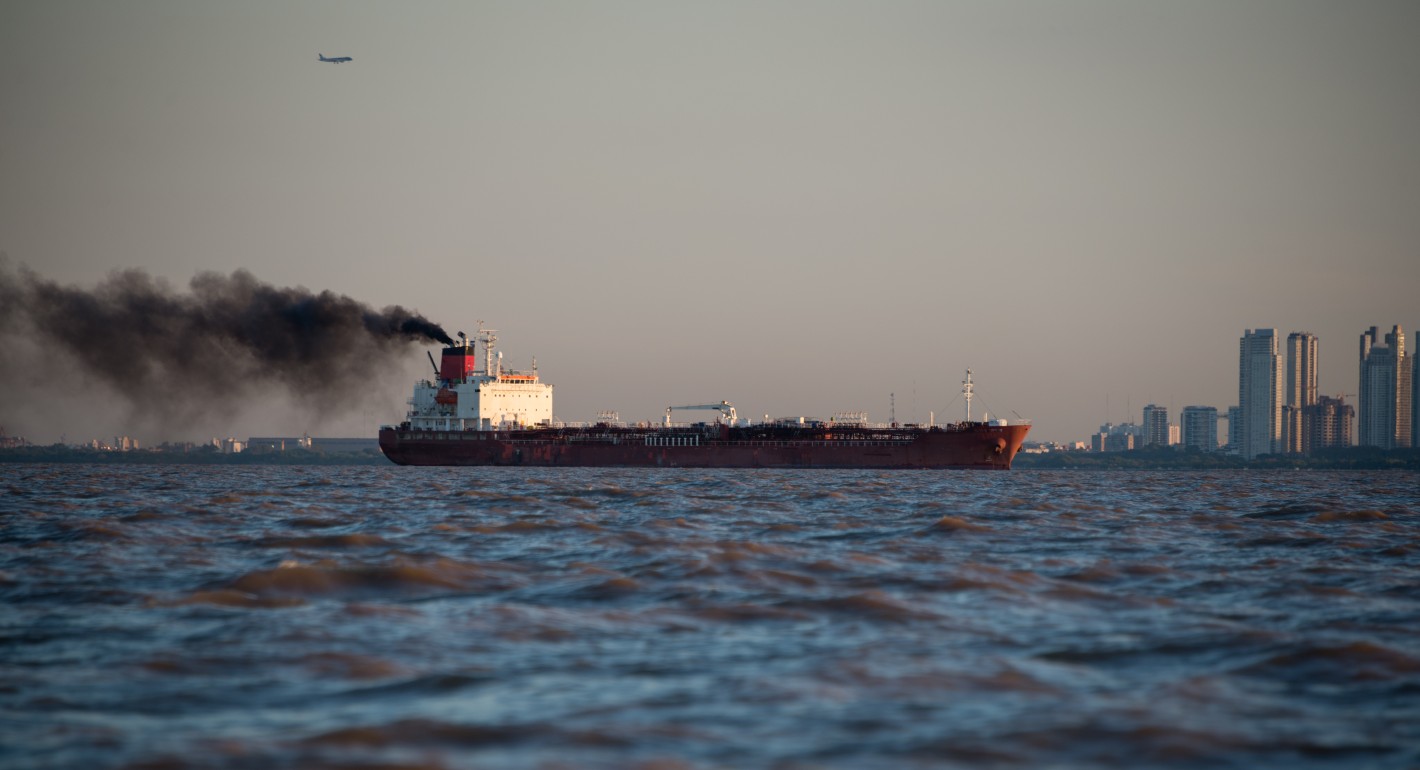
Photo by diegocardini/iStock
The Trump administration’s disruption attempts at the UN shipping agency are a test of multilateralism’s ability to defy the United States.
What is the IMO, and why is there drama around it?
The International Maritime Organization (IMO), headquartered in a beige filing cabinet of a building on the south bank of the Thames in London, writes the rules for international shipping, from plastics to piracy, and each of its 176 members gets one vote. In 2023, members committed to cutting emissions in shipping to net zero “by or around 2050.” The plan to get there, known as the Net-Zero Framework, would amend the part of the IMO’s pollution treaty that covers air emissions to price the greenhouse gases ships emit by burning fossil fuels.
The framework covers the large ships (bigger than a Staten Island Ferry) that produce 85 percent of the industry’s emissions. It sets two clean-fuel standards, a lower bar and a higher bar, that rise every year and count emissions from a fuel’s production to its combustion. Ships that fall short of the higher bar would pay a fixed fee on the shortfall into an IMO-run fund, and ships that also miss the lower bar would pay more. Ships that outperform both bars would earn credits that they can sell to the worst performers to offset part of the heftier fee. In effect, ships that pollute more would subsidize those that pollute less. The fund would then reward the very cleanest ships and compensate poorer countries for the higher costs of shipping and the expense of transitioning to cleaner fuels. Some researchers, however, estimate that the fees may not even raise enough to pay out the clean-fuel rewards, much less fund the transition.
In April 2025, U.S. diplomats walked away from talks over the framework, threatening “reciprocal measures” against any country that backed it. Sixty-three delegations endorsed it anyway. By the next meeting, the Americans were back at the table with everyone else.
Next week, the IMO’s environment committee reconvenes to negotiate the precise set of rules that go up for a vote. If adopted, the IMO would become the first global regulator to make an entire industry pay for its emissions. That vote will test whether a multilateral agency can amass and allocate money that no member freely appropriated—and whether other countries can defy the United States, which would sooner sink this scheme than let others steer it.
Why does the United States object?
The United States objects more to taxes the U.S. Treasury Department neither collects nor spends than to taxing shipping at all. President Donald Trump has declared that “while I am president, there will be no global taxes,” meaning those imposed by an external revenue service. Under the Net-Zero Framework, shipping companies would pay into the fund directly, ultimately passing most of the costs on to cargo owners and consumers.
Americans would pay little, both relatively (because imports make up a small share of the U.S. economy) and absolutely (about $15 per American a year by 2030), but they would also get little back, because few U.S.-owned ships or clean-fuel producers would benefit from the incentives. The chair of the U.S. Federal Maritime Commission said in August that “any viable proposal” must count liquefied natural gas (LNG) toward compliance. That inclusion would drive demand for LNG from its top exporter, the United States—potentially tens of billions of dollars a year if, as she claims, that fuel supplies 60 percent of shipping by 2050.
The Trump administration’s objection to ceding authority to an international body is a familiar American refrain, particularly among Republicans. Officials entertain only voluntary arrangements, calling the framework a global tax “levied by an unaccountable UN organization” and a “global environmental slush fund.” At the same time, in October 2025, the administration began charging port fees on ships linked to China, and in February 2026, it announced a plan to charge every foreign-built ship calling at U.S. ports. These so-called trade remedies suggest that the administration rejects tax revenue set by others, not taxing shipping as such.
In fact, the United States has long refused to support funds whose choices it cannot veto, including in maritime regulation. In 1982, president Ronald Reagan refused to sign the UN Convention on the Law of the Sea (UNCLOS) because its seabed-mining regime would share revenue through a body in which the United States had no veto. The 1994 UNCLOS agreement that won president Bill Clinton’s signature secured that right. Trump’s objections differ more in degree than in kind from those of his predecessors, raising the question of why his administration has not yet quit the IMO, like so many other UN agencies.
Why hasn’t it quit?
The United States would gain little and lose much by leaving. At times, quitting has freed the country from its obligations—as with seabed mining, where the rules reach U.S. firms only with U.S. consent. But in this case, exit would spare the United States nothing, because enforcement runs through foreign ports: The treaty bars ports from treating nonparties’ ships more favorably, so once the world’s major trading hubs join the regime, compliance becomes a prerequisite for trade. Neither quitting nor withholding dues buys the United States a waiver. The Trump administration is bargaining for a carve-out instead of walking out, much like it did during negotiations over the global minimum tax, which would have let other countries tax U.S. firms regardless of U.S. participation.
Not quitting also keeps the Trump administration in a forum it values for other reasons. “Preserving freedom of navigation in all crucial sea lanes” is a top priority in the 2025 National Security Strategy. In his first statement to the IMO Council in July 2026, Ambassador Warren Stephens declared that the United States has “a profound stake in a rules-based maritime order” and pledged that “the United States has been—and will remain—a leading contributor to this organization.” He also cast the IMO as a venue to hold China accountable to the rule of law. But with just one vote, the United States must rely on others to get its way.
How can the Trump administration block a deal most members support?
Of the IMO’s 176 members, only the 108 bound by its air-emissions rules can vote to adopt the framework, and adoption needs two-thirds of those voting, so just over a third of the 108 can block. A motion to adjourn, which postpones the vote while keeping the text, takes a simple majority of votes cast by any of the 176 members. Adjourning draws votes from both sides, because framework supporters who fear losing the vote may prefer to wait, as when Singapore first suggested deferring the October 2025 vote, judging that delay “would best preserve the progress already made.”
Nor would adoption be the final word. Within ten months, one of two groups could band together to scuttle the framework by objecting: a third of the 108, or any coalition of the 108 that collectively hold half of world gross tonnage. Liberia, Panama, and the Marshall Islands alone—which agree that support for the framework “has continued to erode”—hold nearly half of the tonnage. Moreover, the United States is insisting on “explicit acceptance,” which means that the framework would bind only the governments that ratify it, and only once enough have done so. A minority, in other words, can be decisive.
In April 2025, only sixteen countries voted against the text, well short of a blocking third. In October 2025, fifty-seven voted to adjourn the meeting until December 4, 2026. In April 2026, fifty-one delegations argued for reopening the framework, which would restart the clock on adoption, against fifty-five. After that meeting, the State Department claimed “a total collapse in support for the original [Net-Zero Framework] proposal.” With so many demanding changes, the committee invited alternatives, opening a second path to delay: If a simple majority agrees to a substantive edit, the revised text must circulate for another six months. On November 11, the U.S. Federal Maritime Commission chair urged countries to keep submitting amendments.
Is the U.S. strategy working?
Yes, once American diplomats sat back down. Since then, the Trump administration has pressed from every level of government and recruited partners well beyond traditional U.S. allies, notably Saudi Arabia.
Much of Trump’s cabinet has declared that the United States would “not hesitate to retaliate” should others defy it at the IMO. Secretaries Marco Rubio, Chris Wright, and Sean Duffy also put IMO members “on notice” and promised penalties, from port bans on ships to limits on crew visas to sanctions on officials. In London last October, the pressure turned “very personal,” as U.S. representatives went “from delegation to delegation” threatening to limit visas for negotiators and their families, sometimes even during coffee breaks. They told Caribbean delegates they could be blacklisted, and they summoned European delegates to the U.S. embassy, threatening them with lost business. A veteran dealmaker compared the pressure to “dealing with the Mob.” Days before the October 2025 vote, the International Chamber of Shipping expected the framework to pass. Of the sixty-three countries that had approved it in April 2025, fifteen instead voted to adjourn, and ten abstained.
Since April 2026, open U.S. pressure has eased, because the administration no longer needs to defeat an adoption vote and can rely on vetoes other groups hold. Fossil fuel–producing countries supply the votes to adjourn or reopen the text, and flag-of-convenience countries can close ranks to object after any adoption. U.S. diplomats are also helping to draft a rewrite that reportedly drops the IMO fund and returns the fee money to dirty ships in the form of equity in clean-fuel projects. The clearest sign of whether the administration prefers compromise or indefinite delay will come not from the IMO’s December 4 vote but from whether its diplomats back a text that can come quickly to a vote at all.
What could happen before the vote?
The regularly scheduled IMO session ends on December 3, and it must first produce a text to vote on. If it does, the special session that adjourned in October 2025 will reconvene on December 4 to adopt the framework. If the regular session forwards the approved 2025 text with only updated dates, adoption could bring the framework into force as soon as spring 2028. Anything more ambitious than routine edits, however, involves more delay.
What does this mean for the future of U.S. multilateralism?
The United States has not uniformly abandoned international institutions so much as sorted them into those where quitting exempts Americans from undesirable rules, and those where quitting forfeits a spot in a desirable forum. The IMO showdown suggests that where the rules reach U.S. trade anyway, the Trump administration chooses to “get in there and fight, block, tackle, and win,” in the words of Ambassador Mike Waltz. December 4 will offer a sign of whether the administration can get more done by working through the IMO than around it, and of whether majority-rule bodies can impose a tax over a superpower’s objections.
Regardless, shipping will eventually pay for its pollution, if not through the IMO, then through another group’s carbon market. What is uncertain is whether the charges will be global or piecemeal, as levies that stall in international bodies are taken up by small clubs of willing nations. The European Union plans to credit shipowners for IMO payments if the framework is adopted and to review extending its own carbon market—into which shipowners already pay almost $10 billion annually—if it is not. In aviation, France, Spain, Kenya, and five other countries agreed in 2025 to each tax premium flyers nationally, outside the UN’s aviation agency. At COP31 this month, Guinea, Ivory Coast, and Mauritania each signed on to work toward charging ships for their emissions, like Djibouti and Gabon already do.
A similar patchwork outside the IMO would hurt poorer countries most and deepen lock-in to dirty fuels. Kenya’s climate envoy called the framework “necessary” to avoid such a patchwork of taxes “unilaterally imposed,” under which the poorest would still pay higher freight costs, resulting in losses of up to 0.4 percent of their GDP, while the revenue would flow into the treasuries of rich countries, with none returned. On November 18, nine trade groups spanning every sector of shipping implored the IMO to adopt one global rule, warning that such a patchwork would make ships pay twice and that “only global regulation can ensure a level playing field.”
Ultimately, obstruction may not spare U.S. trade the tax. Instead, it would move the revenue from a body in which the United States has one vote to clubs in which it has none. If the United States must pay either way, it does better helping decide where the money goes.
The latest from Carnegie scholars on the world’s most pressing challenges, delivered to your inbox.
Theodore Zaritsky
James C. Gaither Junior Fellow, Global Order and Institutions Program
Theodore Zaritsky is a James C. Gaither Junior Fellow in the Carnegie Global Order and Institutions Program.
Senior Fellow and Director, Global Order and Institutions Program
Stewart Patrick is a senior fellow and director of the Global Order and Institutions Program at the Carnegie Endowment for International Peace. His primary areas of research focus are the shifting foundations of world order, the future of American internationalism, and the requirements for effective multilateral cooperation on transnational challenges.
Carnegie does not take institutional positions on public policy issues; the views represented herein are those of the author(s) and do not necessarily reflect the views of Carnegie, its staff, or its trustees.
As the United States exits UN climate efforts, these smaller and less formal groupings will take on greater significance in global climate governance.
Theodore Zaritsky, Stewart Patrick
The acknowledgment has sparked fears of a new arms race with China and Russia.

Chris O’Meara
Why governance of rapidly evolving technology will be distributed and complex.

Stewart Patrick, Scott Singer
Washington’s decision to support some UN functions while letting others wither is pulling the organization apart at the seams.
Stewart Patrick, Theodore Zaritsky

The move is an escalation of its war on multilateralism.
Stewart Patrick